Best Under-Sink Water Filter (Non-RO)
A carbon (non-RO) filter gives full flow, no wastewater, and cheaper filters — and a NSF/ANSI 53-certified one (the Frizzlife MK99) removes lead without an RO system. Watch the standard number: the popular Waterdrop 17UA is certified NSF 42 + 372 only (its lead/PFAS claims are "tested to"), but it wins on cost — a 24,000-gallon / 3-year filter at roughly $0.004/gallon. Faucet mounts (PUR Plus, Brita) are the certified renter option.
The one thing to know: The sticker price of a water filter is nearly irrelevant next to its filter cost-per-gallon, which spans roughly 300x across formats. A large under-sink carbon cartridge can run about $0.004/gallon, while a ZeroWater pitcher runs ~$0.65–1.00/gallon because its filter is rated only ~15 gallons — a cheap filter that dies in two weeks for a family. Always do the replacement math: a ~$200 RO system quietly costs $60–120 a year in filters, forever.
Our picks — certified reduction to lowest cost
Research-based picks (how we evaluate), from certification listings and specs, not hands-on lab tests. Live Amazon search links, no product prices or ratings, an honest drawback on each.
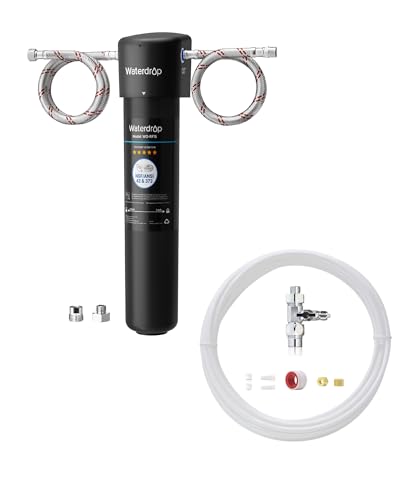
Waterdrop 17UA Under-Sink Filter
Under-sink carbon (non-RO), 24,000 gal / up to 36 mo, IAPMO-certified NSF/ANSI 42 + 372, 0.4 GPM, ~$0.004/gal
A huge 24,000-gallon / 3-year filter life gives by far the lowest cost-per-gallon of any filter here, with a quick twist-change cartridge.
Best for: City-water homes wanting cheap, long-interval taste/chlorine reduction at the tap
Watch out: Certified to NSF 42 + 372 ONLY — its prominent lead/PFAS marketing is 'tested to,' NOT NSF 53 certified; flow is a modest 0.4 GPM and there's no sediment pre-filter.
Check price on AmazonNot deciding today? Add it to your cart over there — Amazon keeps it saved (and flags any price change) until you're ready.

Frizzlife MK99 Under-Sink Filter
Under-sink carbon (non-RO), 2-stage, ~1,600 gal / 6–12 mo, certified NSF/ANSI 42, 53 & 372 (lead via 53)
A genuinely NSF 53-certified under-sink carbon filter — real certified lead reduction without an RO system or wastewater.
Best for: Buyers who want certified lead reduction with full flow and no drain waste
Watch out: Shorter cartridge life (~6–12 months) than Waterdrop's 3-year filter, so recurring cost per gallon is higher; note the Frizzlife 'PD600' is a different (RO) product entirely.
Check price on AmazonNot deciding today? Add it to your cart over there — Amazon keeps it saved (and flags any price change) until you're ready.

PUR PLUS Faucet Mount (FM-3700)
Faucet-mount, 100 gal / ~3 mo, NSF-certified to 42, 53 AND 401 (~99% lead, microplastics, some pharma), ~$0.16/gal
The broadest faucet-mount certification — 42/53/401 including lead and microplastics — for a small upfront cost.
Best for: Renters/buyers wanting certified lead reduction directly at the tap
Watch out: Low flow rate, won't fit pull-out/spray faucets, and the housing can crack/leak over time — the most common complaint.
Check price on AmazonNot deciding today? Add it to your cart over there — Amazon keeps it saved (and flags any price change) until you're ready.
Brita Basic Faucet Mount (BFM-100)
Faucet-mount, 100 gal / ~4 mo, NSF-certified to 42 + 53 (lead, asbestos, benzene, chlorine) — no 401
Certified lead + chlorine reduction at the tap with a longer 4-month / 100-gallon filter life.
Best for: Buyers wanting certified lead reduction at the faucet with fewer changes than PUR
Watch out: Narrower certification than PUR (no NSF 401 for pharma/microplastics), plus the same faucet-fit and low-flow limits as all faucet mounts. Not currently listed on Amazon: we could not find this model in Amazon results, so buying it means going direct or to another retailer. The link below shows comparable options that are on Amazon.
Check price on AmazonNot deciding today? Add it to your cart over there — Amazon keeps it saved (and flags any price change) until you're ready.
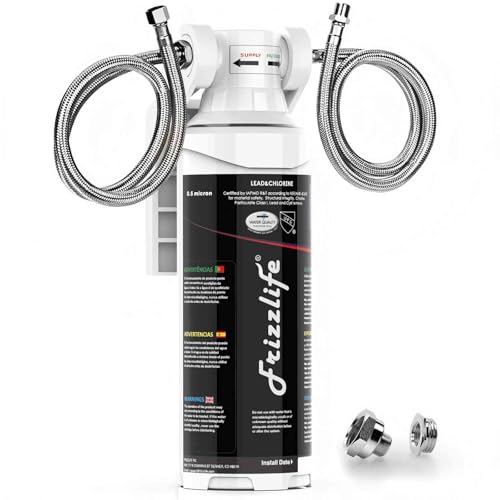
Frizzlife 24,000-Gal 3-Stage Under-Sink (non-RO)
Under-sink carbon (non-RO), multi-stage, high-capacity, certified elements (NSF 42/53/372)
A higher-capacity certified carbon option for buyers who want longer intervals than the compact MK99.
Best for: Households wanting certified carbon filtration with fewer cartridge changes
Watch out: Verify the exact SKU's certified scope before relying on lead (53) claims, and it needs an under-sink connection like all point-of-use carbon systems.
Check price on AmazonNot deciding today? Add it to your cart over there — Amazon keeps it saved (and flags any price change) until you're ready.
Frequently Asked Questions
Yes, if it's certified to NSF/ANSI 53. The Frizzlife MK99 is certified to 42/53/372 for genuine lead reduction with full flow and no wastewater. Note that some popular under-sink carbon filters (like the Waterdrop 17UA) are certified to NSF 42 + 372 only — their lead/PFAS claims are 'tested to,' not NSF 53 certified. Read the standard number.
Carbon (non-RO) filters give full flow, no wastewater, and cheaper filters, and a certified one handles chlorine, taste, and (if NSF 53) lead. RO removes far more — dissolved solids, fluoride, arsenic, nitrates, PFAS — but wastes water and needs a tank or pump. If your water is city-treated and you mainly want taste plus lead, carbon is simpler; if you have many dissolved contaminants, choose RO.
A large under-sink carbon cartridge like the Waterdrop 17UA (24,000 gallons / up to 3 years) is by far the cheapest per gallon — around $0.004/gallon — versus roughly $0.14–1.00 for pitcher filters. If running cost is your priority, a high-capacity under-sink carbon filter is hard to beat.
No — they won't fit pull-out or spray faucets, and they add a bulky attachment with a low flow rate. On a standard faucet they're an inexpensive way to get certified lead reduction (PUR Plus is certified 42/53/401; Brita's is 42/53). The housing can crack or leak over time, which is the most common complaint.
It depends on capacity: the Waterdrop 17UA lasts up to 24,000 gallons / 36 months, while a 2-stage certified filter like the Frizzlife MK99 runs ~6–12 months. Higher capacity means fewer changes and lower cost-per-gallon, so factor replacement cadence into the true cost.